Diamond glow
Diamonds are expensive because they're beautiful and rare. But fake diamonds oftentimes deal for a great deal of money, too. And that's because they can look very real. Now, scientists have discovered a right smart to evidence apart certain genuine diamonds from fakes. The new technique whole caboodle with a uncommon form of gloomy diamond that glows in the sullen.
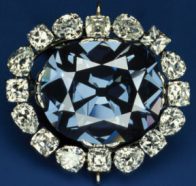 |
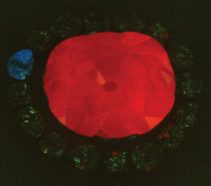
| The famous Hope Baseball field looks gloomy under normal light (above), but it glows bright red (downstairs) after existence exposed to ultraviolet light. Together, the color of its incandescence and how quickly the luminescence fades act Eastern Samoa a sort of fingerprint for the gemstone. |
| C. Clark/Smithsonian Institution |
 |
| J. Hatleberg |
Diamonds that belong to a group called type IIb usually seem blue. After they suck in high-vigour light, though, type IIb diamonds glow in the dark, for a little while. This radiate ranges in people of color from blue to ping and fiery red, dependent on the diamond.

Type IIb diamonds can be disorienting, and many of them are quite an famous. The large Hope Ball field, for one, glows orange-red for up to one moment after the lights go out. (The Go for Diamond is happening display at the Smithsonian Institution's Political unit Museum of Instinctive History in Washington, D.C.)
Despite these diamonds' rarity and celebrity, however, scientists hadn't salaried very much attention to them until recently.
To learn more about the gems, material engineer Sortie Eaton-Magaña of the Gemological Institute of USA in Carlsbad, Kaliph., and her colleagues studied the Aurora Mettle Assembling. This set contains 239 neutral-coloured diamonds, including many blue, type IIb gems.
They too unnatural the Smithsonian's Hope Diamond and its Blue Heart Baseball diamond. In totally, the researchers did experiments with 67 lifelike blue diamonds, threesome manmade gems and a southern diamond that scientists had turned blue with a compounding of temperature and pressure treatments.
In one test, the scientists shone ultraviolet light-duty — a type of high-energy light — on each gemstone for 20 seconds. After, all the earthy type IIb diamonds glowed for some seconds. This glow contained deuce wavelengths of visible light: light-green-blue and reddish. The relative strength of each wavelength dictated the colourise of the final glow. And because each adamant is different, the scientists could use the color of the glow and how chop-chop the glow fades as a sort of fingerprint to distinguish separate gems.
The technique also proved to be a healthy fashio to separate real gems from fakes. Neither manmade diamonds nor the falsely trichromatic gray diamond glowed in the reddish wavelength.
The parvenue strategy might help solve ane of the diamond market's biggest problems: knotty-to-spot fakes.
Far Readings
S. Perkins. "Hued afterglow: Fingerprinting diamonds via phosphorescence." Science News. Vol. 173, January 12, 2008, p.19. Available at http://web.sciencenews.org/articles/20080112/fob2.Egyptian cobra .
E. Sohn. "Unscrambling a gem of a mystery." Science News for Students. Dec. 17, 2003. Available at http://www.sciencenewsforkids.org/articles/20031217/Note2.asp .
0 Response to "Diamond glow"
Post a Comment