Finding a voice through A Level Art & Design
Last Updated on Jan 5, 2022
This commodity features the A2 Coursework projection of Emily Fielding, completed while studying Edexcel A Level Art and Blueprint at Kennet School, Berkshire, England (2014). Emily gained 100% (A*).
Some of Emily's sketchbook pages are included in our new volume: Outstanding Loftier Schoolhouse Sketchbooks . This volume has high-resolution images and so that fine details and note are articulate, making it an excellent resources for students and schools. Larn more than!


Throughout my teenage years, art has always been a form of outlet and personal enjoyment. I started my secondary school teaching at Kennet Schoolhouse in Berkshire back in 2008, where my older sister Rebecca had already been attention for 3 years. As I come from a creative family, Rebecca had merely started her GCSE Art & Design – and I was in awe! Seeing the work produced in sketchbooks using unlike media seemed such an heady concept for me. Drastic to start practicing unlike art skills, I created a Youtube channel and published a range of art videos, which has now been running for six years – about the entire length of my school career. This gave me the determination to refine fine art skills outside of school, which I really recommend for anyone looking to improve the quality of their piece of work. My school also held an annual 'House Art Competition' where students from across the school could contribute work from their studies – GCSE and A Level students from my younger years at Kennet became a massive inspiration and motivation to create stunning fine art.
Soon, five years had passed and I had completed my GCSE Art & Design qualification – amazingly achieving total marks (A*) in both my coursework and exam work for both years! I then connected into 6th Form at Kennet School to study Art & Design for ii years, along with three other subjects. In the starting time year, this was separated into four separate units in the coursework – ceramics, art, graphics and textiles. This actually gave me the opportunity to explore different mediums, techniques and textures and to actually find what I liked. Any pupil that is potentially looking for a career in fine art or something creative begins to detect their voice at this level. When you lot truly beloved something, whether information technology's a item style of art or creative person, you feel a gravitational pull towards it. My communication is run with it! I truly believe this is one of the key ingredients in creating a successful sketchbook.
After my first successful year of A Level Fine art & Design with another 100% accomplished, I moved into my final year of school in the autumn of 2014. The beginning of A2 Art & Design involved a Coursework project and, due to it beingness the last level of the qualification, we were given consummate independence when selecting the 'theme'. The upshot of this Coursework project was non only a sketchbook and concluding piece, but likewise an essay going into more than academic detail of the unlike artists I researched in the project.
For this projection I decided to select the theme of 'The Human being Form'. I felt that this was broad enough to include a broad diversity of unlike styles of artists as well as being an area of art that actually interested me. To give the project more depth, I as well wanted to look at a more historical arroyo to the human being form – enabling me to contrast not but the styles of art but also looking at how fine art has developed over the past few centuries. This is valuable cognition to gain an agreement the origins of art, which I besides found enhanced my appreciation of the subject area.
I began by visiting the National Portrait Gallery in London. This has a key link to my projection and shows commitment – something that exam boards love to see! If you are currently studying Art and have museums most yous, information technology is worth a visit. You will exist surprised how much yous will actually bask it.
I completed a range of observational studies in relation to my theme of the 'Human being Form' early on in the project, demonstrating an agreement of different mediums. I selected to practice many observational drawings, as I felt this was one of my strengths. If in that location is a surface area of Fine art & Design that yous are particularly adept at, at this stage of the A Levels Art project, it is such a great opportunity to testify off what you're good at!
I then moved on to research my first artist Leonardo da Vinci – my historical section of the project. Every bit da Vinci is such an icon in both the art and science earth, I felt it was essential to include this research, every bit it has such a clear link the theme of the human class. He had such an influential office in portraying the human form as 'realistic' and 'anatomically' correct, which changed the manner of art in the Renaissance period. When presenting my artist research, I painted one of da Vinci'southward pieces – not only did this give me the opportunity to understand the process behind his paintings, just it helped me to think about how I could interpret the way within my ain work.
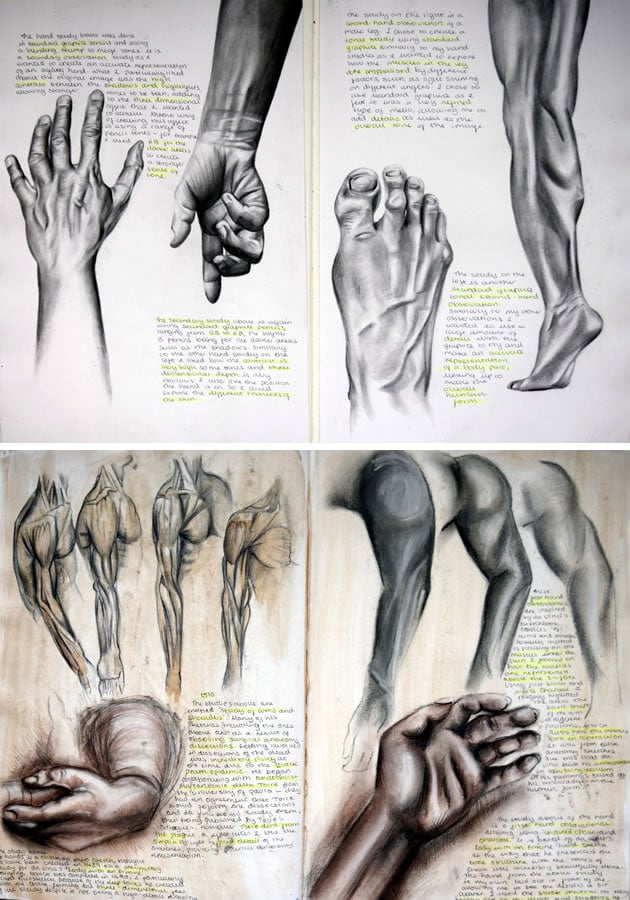
To show that I was aware of the more than technical side of art I besides did some extended research into different Renaissance painting techniques – once more allowing me to understand the process backside older paintings and then being able to transfer this into my responses.
Once I had thoroughly researched da Vinci and the techniques and composition styles he used in his piece of work, I then conducted my own photo-shoot of a homo model. Having your own photographs to piece of work from makes your life easier when designing a composition and shows independence and understanding of the direction y'all wish to accept. It as well teaches you lot how to take photographs. Subsequently experimenting with different compositions, I created a large scale version – challenging myself to work in a variety of different formats.
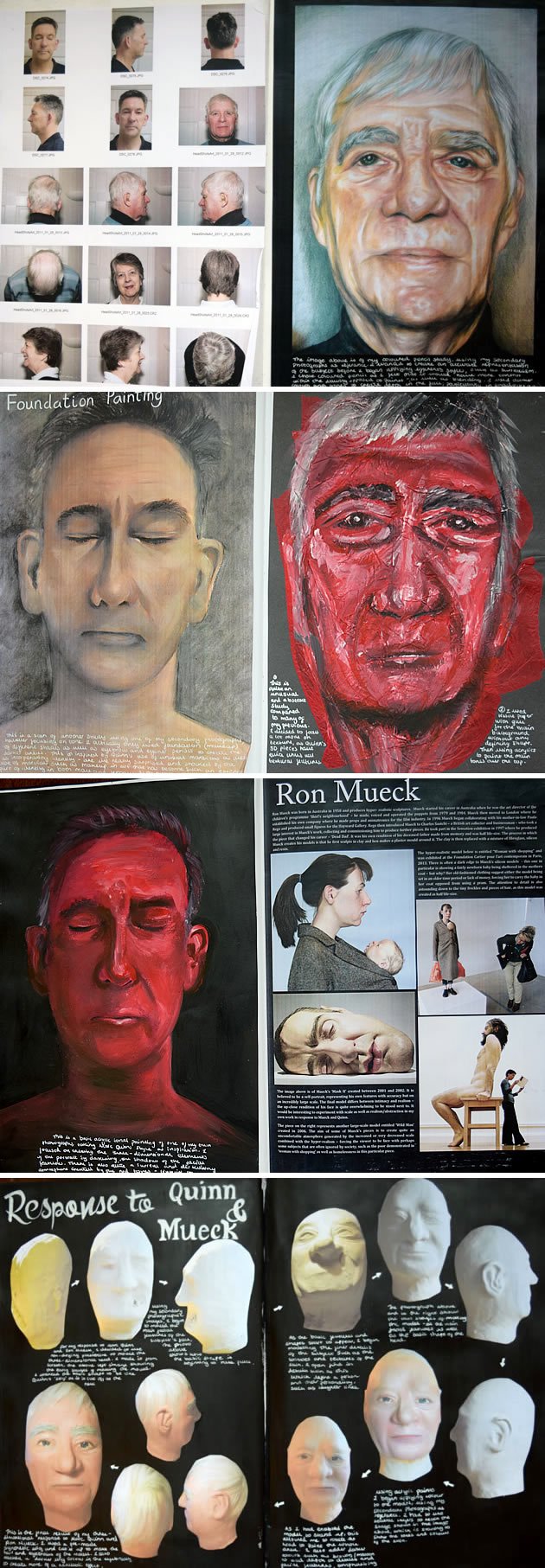
The next artist that I researched was contrastingly very modernistic – Marc Quinn. I thought it would exist interesting to look into someone that provided a more controversial take on the human form – his famous sculpture of Alison Lapper was displayed in Trafalgar foursquare and created some uproar. Information technology challenged the social ethics of beauty and what should exist involved in fine art. The fact that his work was virtually always three-dimensional also meant I would have to make a three-dimensional response, which I was really excited about. Before in the year, before I started this A Level projection, I started to await at courses that involved prosthetics for film and television – therefore as a part of my portfolio I needed to have some three-dimensional elements. I particularly loved Quinn's unusual approach to sculpture and was excited to experiment with dissimilar materials.
I followed the aforementioned process as my da Vinci research, looking into technical processes that related to Marc Quinn's art and then producing observational studies linking to him. As Marc Quinn is also known for his experimental use of textures, I produced some pieces of piece of work playing around with dissimilar textures. As I hadn't really found a detail style of two-dimensional texture that interested me enough to create a response to Marc Quinn, I then added in an extra small artist research of Ron Mueck (who creates hyperrealist sculptures of humans). I think this is a completely acceptable and almost encouraged in your sketchbook – if you have chosen an artist that you lot are struggling to translate within your ain work then why not add other artists in? This gave me the inspiration to create a realistic 'head' sculpture fabricated out of plasticine and coloured with paints.
As many A Level Art students volition know, many projects are very fast paced and the amount of work expected means you don't accept a lot of time to get 'stuck'. My communication is – if you don't similar the management yous are going in, change it! As long every bit you explain why you don't remember information technology is working, you tin can then move in a management that yous like. It volition actually give you more an edge, equally you are expressing your honest opinions virtually the process you lot are going through.
As I wanted to cover many different art styles in this project, to evidence versatility, I then did an creative person research of Cristiano Siqueira, known as CRISVECTOR, a digital graphic artist. I did a few studies of his work every bit two-dimensional drawn pieces to explore the types of patterns and colours that he used in his work. Equally colour was a major part of CRISVECTOR's piece of work, I decided to look at the human form effectually the world that had color as a major part of their civilisation. I did an original acrylic painting of a portrait and then experimented with digital painting. I really enjoyed experimenting with this area of fine art and decided to take this item portrait farther, moving into more than textile territory past beginning to stitch into the prototype to show the patterns that CRISVECTOR would too use in his piece of work. This is another clear example to the examiner that I was willing to experiment and try new things. I also tried printing processes and dry out-point carving onto patterned backgrounds – a way that I vicious in love with!
Information technology was during the fourth dimension that I was researching and responding to the piece of work of CRISVECTOR that I found a passion for portraits of people from across the globe, particularly India. I loved the colours oftentimes involved in their everyday life which differs and then much from British club. I also specially loved existence able to explore the texture of the pare especially through acrylic paints. I honestly feel that it was during this particular project that I started to find my voice/passion for a particular surface area of art, which I have carried through into my electric current university life.

Equally culture suddenly started to play a larger office in my project, I again conducted my own photo-shoot to use for reference images. I went through the aforementioned process of experimenting with different compositions earlier once more creating a large scale piece in response to Vector.

I and so moved onto 1 final artist, Cristina Troufa. I loved her minimalist style of painting and representation of the incomplete man body, near suggesting that we are still growing and developing. Again, I was particularly drawn in with her choice of colours – I found the brilliant mix of the skin assorted heavily against the grayness background very aesthetically pleasing. I went through the aforementioned process of conducting a photo-shoot, before beginning to await at different composition designs.
Every bit I had already looked at the previous artists in such depth and I was reaching the end of the project, I started to think of experimental ways to incorporate Troufa'south piece of work into my final piece, besides as some of the skills that I had learnt throughout the projection. I challenged myself to come up with different ways of presenting the limerick and looked at spreading it over two canvases whilst being interconnected with string. I thought it was a clear representation of the human form and a successful resolution to my entire project. I felt that it actually expressed my passion of more than hyperrealist art, as well as connecting to the cultural aspect that I began to find.

My advice for creating a successful sketchbook is honestly to but choose areas of art that really intrigue yous. You will be surprised how easy it is to observe your voice every bit an individual artist and how much you volition enjoy doing your Coursework project. I often get questions near time management and how I managed to complete so much work in a brusque infinite of fourth dimension – the hush-hush is to find something that interests you enough that you lot are actually excited to work on your sketchbook and it no longer feels like a chore!

Emily's total A Level Fine art Coursework sketchbook can exist viewed below. Please note that this contains life drawing (human form), then discretion for younger viewers may be brash:
Some of Emily's sketchbook pages are featured in our upcoming publication – read more about this here!

This commodity was written past Emily Fielding. Emily gained 100% (full marks) in GCSE Art & Design, A Level Fine art & Design and A Level Photography. She currently studies make-up and prosthetics for film/television at the University of Arts London (UAL) and has over 22,000 subscribers on Youtube.
Source: https://www.studentartguide.com/featured/find-a-voice-a-level-art
0 Response to "Finding a voice through A Level Art & Design"
Post a Comment